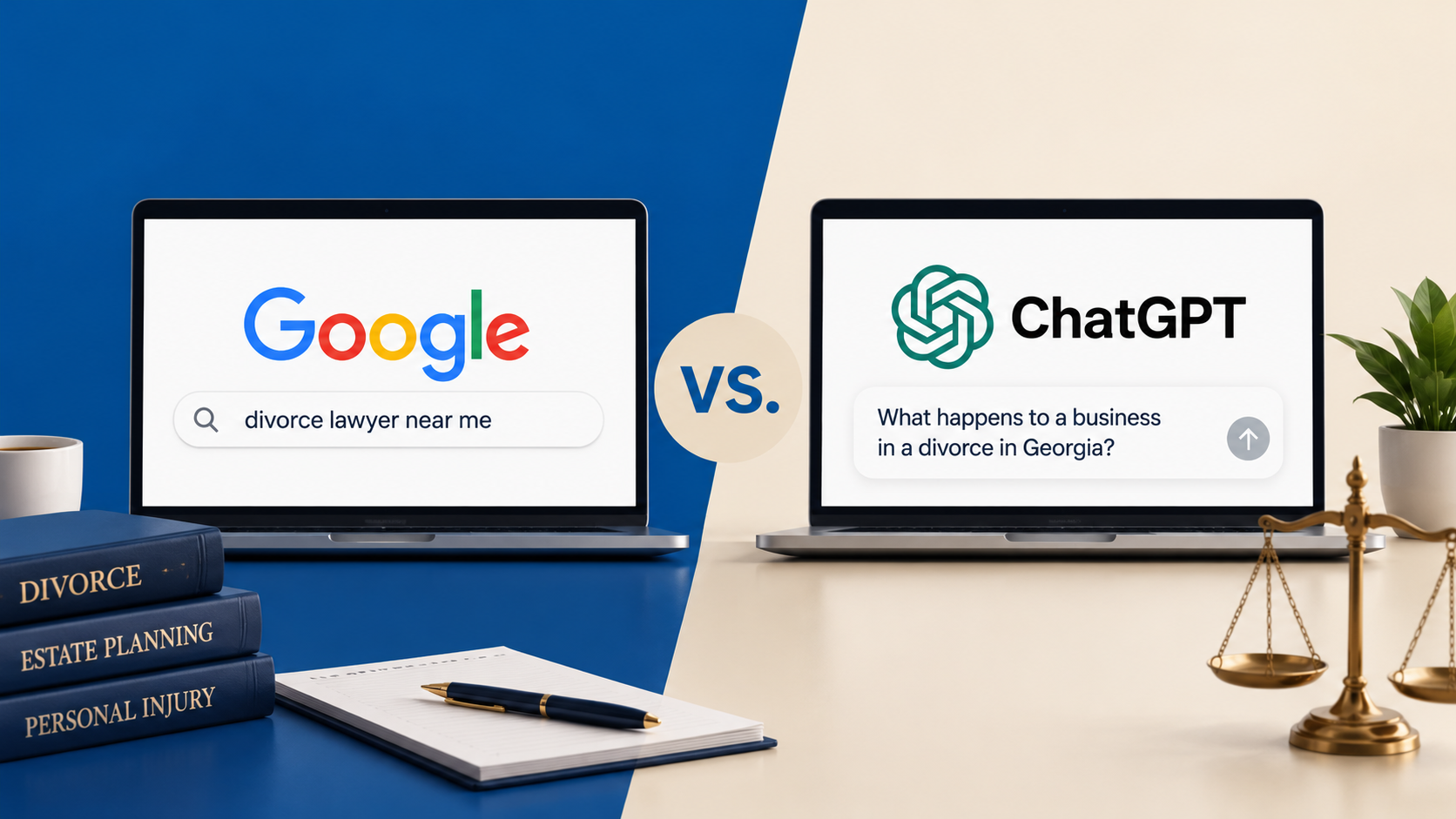
Why law firms need both traditional SEO and AI search visibility to compete in 2027
For years, the goal of law firm search engine optimization (SEO) was relatively straightforward: Get your website to appear on the first page of Google when someone searches for an attorney or information about a legal problem.
Today, that strategy is no longer enough.
Google remains the dominant search engine, but ChatGPT has emerged as a powerful alternative for people researching questions, comparing options, and looking for answers. And with Google incorporating AI Overviews and AI Mode into its own search experience, the distinction between traditional search and AI-powered discovery is becoming increasingly blurred.
For law firms, the question is no longer whether Google or ChatGPT will win. It's whether prospective clients can find your firm wherever they choose to search.
Google vs. ChatGPT: What the Numbers Tell Us
According to a 2026 market share analysis from First Page Sage, Google continues to account for the majority of digital search activity, while ChatGPT has become a significant competitor.
Estimates suggest:
Google Search: Approximately 56% to 80% of digital query activity, depending on how searches and AI interactions are measured.
ChatGPT: Approximately 18% to 19% of digital query activity under broader definitions that include conversational AI.
Other platforms: Bing, Perplexity, Gemini, and other search and AI tools account for smaller portions of activity.
These estimates are not directly comparable to traditional search engine market share figures. Different studies count different activities, including conventional searches, AI prompts, and other digital queries.
Another important distinction is website traffic. Google still generates the overwhelming majority of search referral visits to websites, while ChatGPT and other AI platforms account for a much smaller share.
What does this mean for law firms?
Google should remain a primary investment for organic visibility and local lead generation. However, ignoring ChatGPT and other AI platforms could mean missing opportunities to reach potential clients earlier in their decision-making process.
How People Search on Google vs. ChatGPT
One of the biggest differences between Google and ChatGPT isn't simply how many people use them. It's how they use them.
Google: Finding a Lawyer When You're Ready to Act
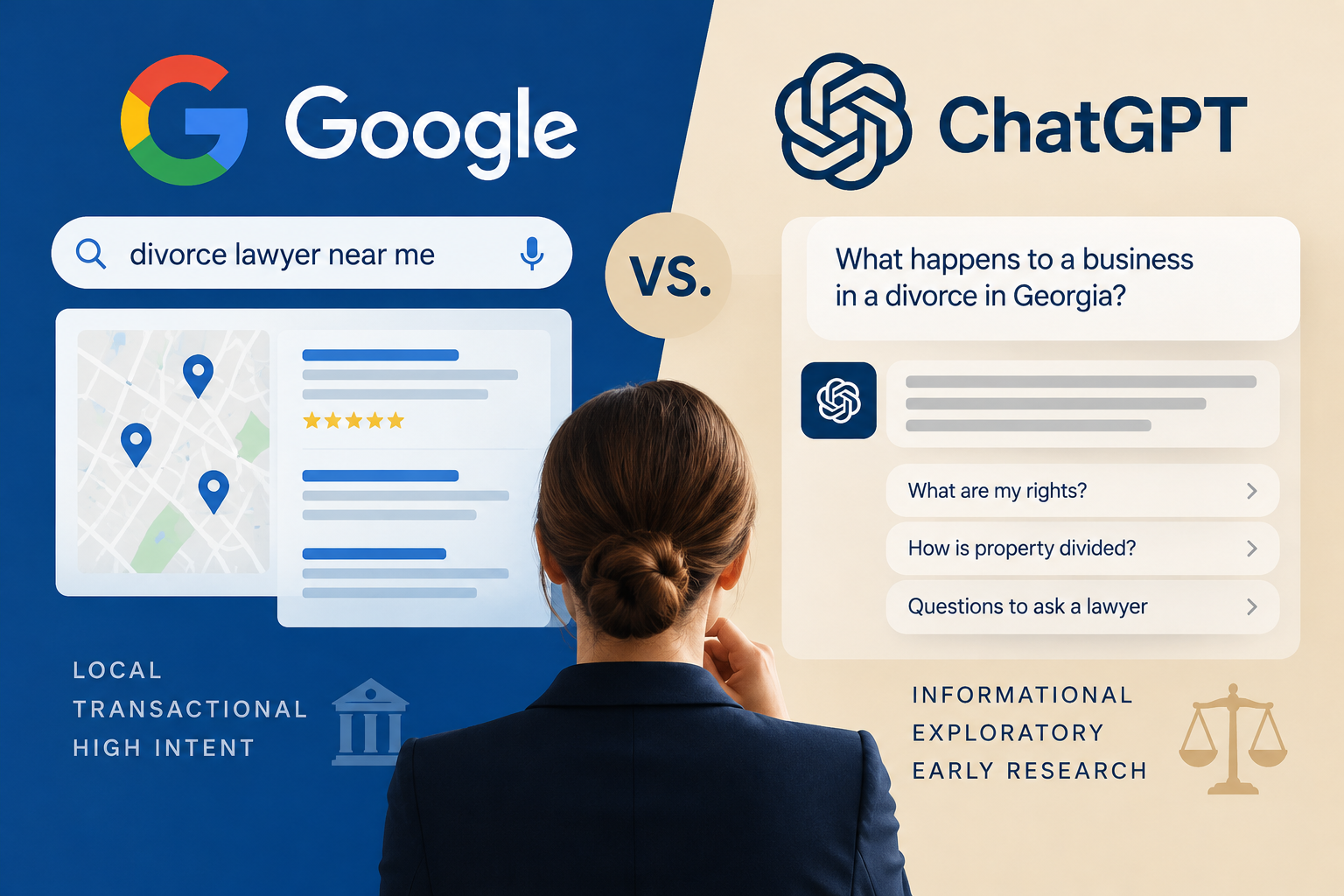
Google remains especially important for searches with immediate local or commercial intent.
For example, someone might search:
Divorce lawyer near me
Best personal injury attorney in Atlanta
Immigration lawyer in New Jersey
Probate attorney in Chicago
Workers' compensation lawyer free consultation
These searches often indicate that someone has identified a legal need and may be ready to contact an attorney.
Google responds with a combination of local business listings, maps, organic website results, paid advertisements, and sometimes AI-generated answers.
This makes traditional SEO, local SEO, and Google Business Profile optimization essential for law firms.
ChatGPT: Understanding a Legal Problem Before Hiring a Lawyer
ChatGPT is particularly useful for conversational, informational, and exploratory searches.
Instead of typing a few keywords, a prospective client might ask:
"My spouse and I own a business together. What happens to the business if we divorce in Georgia?"
"My employer fired me after I reported a workplace injury. What are my rights in Florida?"
"My mother died without a will in Illinois. What should our family do first?"
"Can I apply for a green card if I entered the United States legally but overstayed my visa?"
"What should I look for when choosing an attorney for a complicated child custody case?"
These are longer, more detailed questions that often arise before someone is ready to schedule a consultation.
ChatGPT can help users explore the issue, understand terminology, identify possible legal considerations, and develop follow-up questions.
When search functionality is available, it may also retrieve information from websites and cite sources.
The opportunity for law firms is to become a credible source of information during this early research stage, not just when someone is ready to hire an attorney.
The Changing Legal Client Journey
Consider how someone facing a complicated divorce might search for help.
Traditional Google search journey:
Search "divorce attorney near me."
Review Google Maps and local listings.
Visit several law firm websites.
Read reviews and attorney biographies.
Contact a firm for a consultation.
AI-assisted search journey:
Ask ChatGPT how divorce might affect a jointly owned business.
Ask follow-up questions about property division and financial disclosures.
Research potential legal strategies and questions to ask an attorney.
Look for lawyers with relevant experience.
Use Google, law firm websites, reviews, and other sources to evaluate attorneys before contacting one.
These journeys are not mutually exclusive. A prospective client may use ChatGPT for initial research, Google to find nearby attorneys, YouTube to watch an attorney explain an issue, and LinkedIn or review sites to assess credibility.
This is why law firms must begin thinking beyond Google rankings alone.
Why Google Still Matters Most for Local Law Firms
Despite the rapid adoption of AI tools, Google remains especially important for attorneys serving specific cities, counties, and states.
Someone searching for "family lawyer in Lawrenceville GA" is often much closer to contacting an attorney than someone asking ChatGPT to explain the difference between contested and uncontested divorce.
For these high-intent searches, law firms should continue prioritizing:
An accurate, complete Google Business Profile
Consistent business name, address, and phone number information
Relevant local service pages
Detailed attorney biographies and credentials
Authentic client reviews that comply with applicable rules
Fast, mobile-friendly websites
Helpful content that answers location-specific legal questions
Google's AI Overviews and AI Mode also make high-quality website content important for AI-generated search experiences.
Traditional SEO isn't disappearing. It's becoming part of a broader search visibility strategy.
How Law Firms Can Improve Visibility in ChatGPT and AI Search
Unlike traditional Google search results, ChatGPT does not provide a fixed ranking position that law firms can optimize for.
AI-generated answers can vary based on the user's question, location, context, available sources, and the model or search experience being used.
There is no guaranteed method to make ChatGPT recommend a particular law firm.
However, firms can improve their chances of being discovered, cited, and considered by building a strong, credible online presence.
1. Publish Content That Answers Real Legal Questions
People increasingly search using natural language rather than short keyword phrases.
Law firm websites should reflect that behavior.
Instead of publishing only a generic article titled "Georgia Divorce Laws," consider more specific questions:
Can my spouse claim part of my business in a Georgia divorce?
What happens when parents disagree about school choice after divorce?
Can a divorce agreement be modified after the final order?
These questions provide opportunities to create useful, relevant content that serves both traditional search and AI-assisted research.
2. Prioritize Original, Non-Commodity Content
AI can already generate basic explanations of legal topics.
A law firm's competitive advantage comes from publishing information that reflects its attorneys' actual experience, professional judgment, and understanding of the communities they serve.
That might include:
Anonymized case studies
Attorney commentary on legal developments
Frequently misunderstood legal procedures
Practical examples drawn from experience
Jurisdiction-specific explanations
Answers to questions clients regularly ask
For example, a generic blog explaining child custody laws provides basic information.
An article discussing "What Georgia Judges Consider in High-Conflict Custody Disputes" can provide a more distinctive perspective, particularly when it incorporates insights from an experienced family law attorney.
Read more: Commodity vs. Non-Commodity Content: Why Law Firms Must Stop Publishing Generic Blogs
3. Build Authority Beyond Your Website
AI search visibility is not limited to your website.
Potential sources of information and credibility include attorney biographies, professional directories, reputable publications, community organizations, and public discussions.
A law firm that publishes consistently on its website, maintains accurate professional profiles, and earns credible third-party mentions creates more opportunities to be discovered and evaluated.
Consistency matters. Your firm's name, practice areas, attorney credentials, and service locations should be accurate wherever they appear online.
4. Connect Social Media With Your SEO Strategy
Social media is becoming an increasingly important part of online discovery.
Research highlighted in our October blog found that social media links appeared in approximately 67.66% of Google AI Overview responses in a study of 100,000 keywords.
The same research found that social platforms appeared in different proportions across Google AI Mode and ChatGPT responses.
This doesn't mean every social media post will appear in an AI-generated answer. It does mean law firms should stop treating social media and search visibility as completely separate marketing activities.
Consider turning a substantive blog into a LinkedIn post, a short attorney video, a YouTube explanation, and a series of helpful FAQs.
Each format provides another opportunity for prospective clients to encounter your expertise.
5. Make Your Website Easy to Understand and Navigate
A well-organized website benefits visitors, search engines, and systems that retrieve web content.
Important elements include:
Clear headings and descriptive page titles
Dedicated pages for individual legal services
Relevant internal links
Accurate attorney credentials and firm information
Descriptive, useful FAQs
Current legal information and appropriate source references
Structured data where applicable
The goal is not to write for an algorithm. It's to make your expertise accessible and understandable.
6. Monitor Both Traditional Search and AI Visibility
Law firms should continue using Google Search Console and Google Analytics 4 to measure website performance.
Useful metrics include organic search clicks, impressions, engagement, consultation requests, and traffic to key practice area pages.
In GA4, firms can also examine referral traffic from identifiable AI platforms, although this data does not capture every interaction or brand mention that occurs within an AI-generated answer.
AI visibility can be assessed separately by testing relevant legal questions and monitoring whether a firm is cited or mentioned across different AI search experiences.
Keep in mind that these results are variable and should not be treated as fixed rankings.
The most meaningful measurement is whether increased visibility contributes to qualified inquiries and new clients.
Are Younger Legal Consumers Changing How Attorneys Will Be Found?
Younger consumers are often more comfortable moving between conversational AI, social media, video, and traditional search.
Someone researching a legal issue may ask ChatGPT for an explanation, look for a short video on YouTube, review discussions on Reddit, and then use Google to locate a nearby attorney.
Older consumers also use multiple digital platforms, and Google remains important across age groups.
The lesson is not that every law firm needs to be active on every platform.
It's that firms should understand where their target clients seek information and develop content that meets those needs.
For attorneys hoping to attract younger clients in family law, immigration, personal injury, and estate planning, this increasingly means providing information in more than one format.
Google vs. ChatGPT: Frequently Asked Questions for Law Firms
1. Is ChatGPT replacing Google Search?
No. Google remains the dominant source of traditional search traffic and is especially important for local and commercial searches. ChatGPT is becoming a significant complementary research tool, particularly for complex or conversational questions.
2. Can my law firm rank in ChatGPT?
ChatGPT does not offer traditional, stable rankings like Google's organic search results. However, firms may be mentioned or cited in AI-generated responses. Publishing authoritative content and maintaining a credible online presence can support discoverability, although no specific recommendation is guaranteed.
3. Should law firms invest in AI optimization instead of SEO?
No. Law firms should continue investing in SEO while adapting their content for AI-assisted discovery. Strong website content, accurate business information, technical accessibility, and credible third-party references can benefit both approaches.
4. Does social media help law firms appear in AI search?
Social media content can be surfaced or cited by AI-powered search tools, depending on the platform and search experience. An active, useful social presence can also help strengthen brand awareness and professional credibility.
5. What type of content works best for Google and ChatGPT?
Content that answers real questions, demonstrates relevant legal expertise, provides jurisdiction-specific information, and is clearly organized can serve both traditional and AI-powered search. Original attorney insights and practical examples help distinguish a firm's content from generic legal information.
Law Firms Need to Be Found Wherever Clients Search
The rise of ChatGPT does not signal the end of Google or traditional SEO.
Instead, it reflects a fundamental change in how people discover information, evaluate expertise, and make decisions.
Google continues to play a critical role when prospective clients are actively looking for legal representation. ChatGPT and other AI tools create additional opportunities to reach people while they are still researching and trying to understand their legal options.
For law firms preparing their marketing strategies for 2027, the smartest approach is not choosing one platform over the other.
It's building a consistent, authoritative digital presence that helps prospective clients find and trust your firm across Google, AI search, and other online channels.
Is Your Law Firm Ready for AI-Powered Search in 2027?
At SEO My Law Firm, we help small law firms build their online visibility through strategic legal content writing, SEO-focused website copy, original blogs, FAQs, and content that demonstrates real attorney experience.
We believe effective legal content should do more than attract clicks. It should establish credibility, answer the questions prospective clients are asking, and help turn online visibility into meaningful opportunities for your practice.
Let's discuss how a smarter legal content strategy can help your firm compete in both traditional and AI-powered search.
Visit https://www.seomylawfirm.com/ to learn more.