AI Favors Brands With an Active Social Media Presence: Why Law Firms Can No Longer Separate Social Media From SEO
New research reveals that social media content is appearing in AI-generated search results. Here's what attorneys need to know about building visibility, credibility, and attracting new clients.
For years, many law firms have treated search engine optimization (SEO) and social media marketing as two separate strategies.
SEO was about getting your law firm's website to rank on Google. Social media was about building relationships, sharing firm news, and staying connected with your community.
Artificial intelligence is changing that distinction.
A new study from SE Ranking, highlighted in an October 2026 Social Media Today article, suggests that social media is becoming an increasingly important source of information for AI-powered search engines.
For law firms investing in SEO, Answer Engine Optimization (AEO), and AI search visibility, the findings reinforce an important message:
Your law firm's online visibility no longer depends solely on what appears on your website. It also depends on where your attorneys and your firm appear, what they publish, and how consistently they demonstrate their expertise across the internet.
New Research: AI Search Engines Are Citing Social Media Content
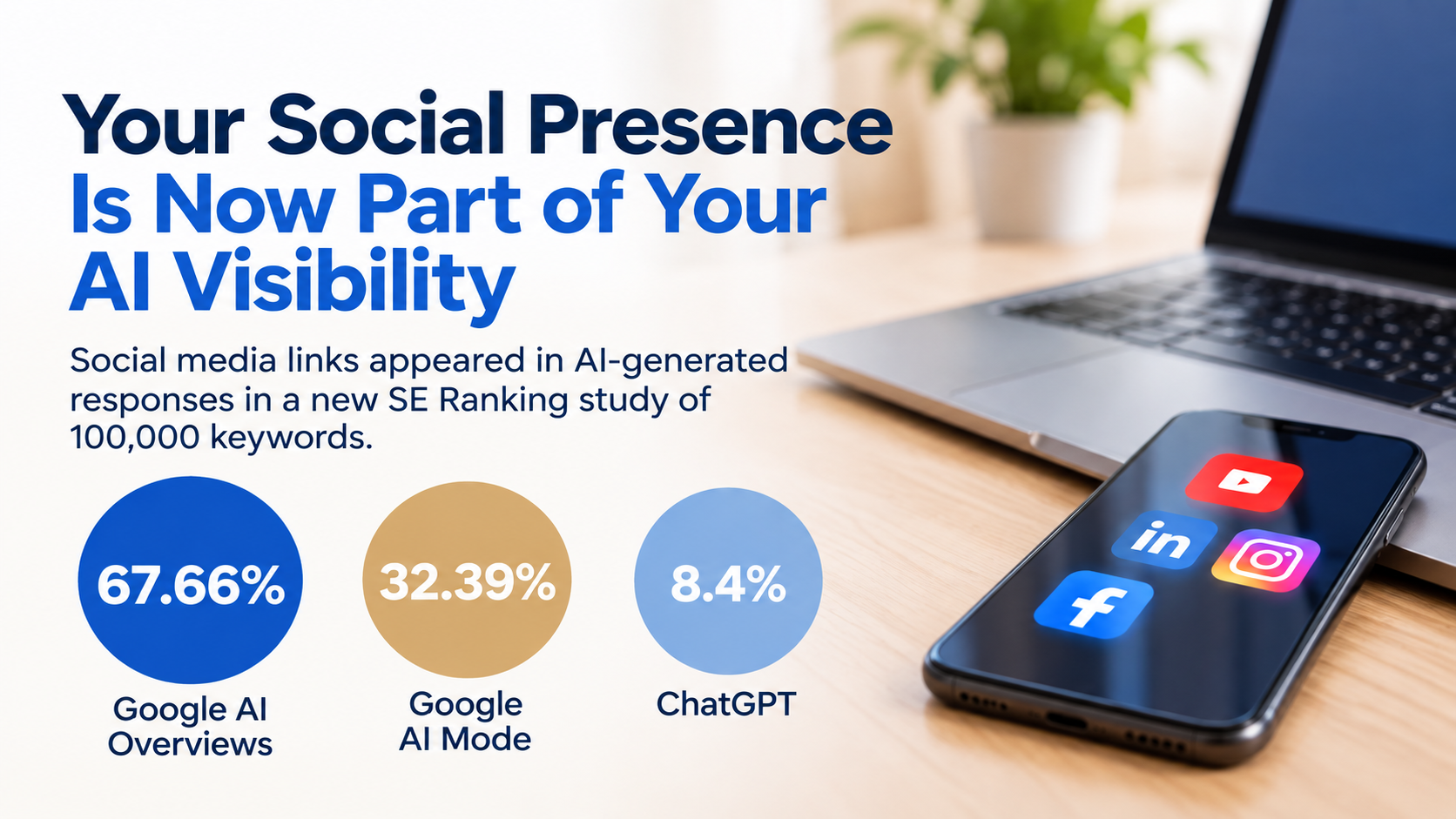
SE Ranking analyzed 100,000 keywords across multiple industries to understand how frequently social media platforms appear in AI-generated search responses.
The results demonstrate how differently AI search tools use social content.
AI Search Platform Responses Containing Social Media Links
Google AI Overviews 67.66%
Google AI Mode 32.39%
ChatGPT 8.4%
Source: SE Ranking research, reported by Social Media Today, October 7, 2026.
These percentages represent the share of responses containing at least one social media link, not the percentage of citations from social media or the likelihood that an individual law firm will be mentioned.
Nevertheless, the findings are significant.
More than two-thirds of the Google AI Overview responses studied included a social media source.
√ YouTube was the most frequently cited social platform in Google AI Overviews.
√ Reddit and LinkedIn led among the social sources appearing in ChatGPT answers, although individual social platforms appeared in relatively few ChatGPT responses.
The takeaway is not that social media replaces traditional SEO.
It's that law firms need a more connected approach to how they publish, distribute, and promote their content.
Read the full article: AI Favors Brands With an Active Social Media Presence - Social Media Today
Your Social Presence Is Now Part of Your AI Visibility
Digital marketing strategist and author Neal Schaffer summarizes the shift:
"Your social presence is now part of your AI visibility."
That observation is especially relevant to attorneys.
Potential clients are no longer discovering law firms through Google search results alone. They are also asking AI-powered tools questions such as:
Who is an experienced immigration lawyer in New Jersey?
What should I do after a car accident in Atlanta?
How can I avoid probate in Illinois?
What questions should I ask a divorce attorney?
Can a lawyer help me appeal a denied VA disability claim?
AI-generated responses may draw on websites, articles, videos, professional profiles, and other publicly available sources.
When a law firm consistently publishes useful, original content across multiple channels, it creates more opportunities for prospective clients to encounter its expertise.
That does not guarantee an AI recommendation or citation. However, it gives the firm a broader digital presence than a website alone.
Which Social Media Platforms Matter Most for Law Firm AI Visibility?
The research highlights an important distinction: Different AI platforms favor different information sources.
That means law firms should not assume that posting the same content everywhere will produce identical results.
1. YouTube: An Opportunity for Attorneys to Demonstrate Expertise
YouTube was the most commonly cited social source in Google AI Overviews in the study.
For law firms, YouTube provides an opportunity to answer common legal questions through educational videos.
Examples include:
A family law attorney explaining what happens at a temporary custody hearing.
An immigration lawyer discussing common reasons an I-751 petition may be delayed.
A personal injury attorney explaining what to do after a commercial truck accident.
An estate planning lawyer describing the difference between a will and a trust.
These videos can also support your website content.
For example, an attorney could publish a blog answering a frequently asked legal question, create a short video discussing the same issue, and embed that video in the article.
SEO My Law Firm Tip: Treat YouTube videos and Shorts as extensions of your law firm's legal FAQ library. Use descriptive titles, accurate captions, clear explanations, and links to relevant pages on your website.
2. LinkedIn: Build Attorney Authority and Professional Visibility
LinkedIn offers attorneys a valuable opportunity to establish professional credibility.
Rather than simply sharing links to new blogs, attorneys can use LinkedIn to discuss legal developments, explain court decisions, provide commentary on industry trends, and share insights drawn from their professional experience.
For example:
A generic LinkedIn post might say:
"Learn more about child custody in Georgia. Read our latest blog."
A more valuable post could explain:
"Three issues Georgia judges may consider when parents disagree about a child's school placement."
The second example demonstrates legal knowledge and provides useful information without requiring the reader to leave LinkedIn.
For law firms, this is an important distinction.
Your attorneys' professional insights are content assets that generic AI-generated articles cannot easily replicate.
3. Facebook and Instagram: Strengthen Local Visibility and Community Connections
Facebook and Instagram remain useful for law firms serving specific geographic communities.
These platforms help attorneys communicate their practice areas, share educational content, introduce team members, and highlight community involvement.
Consider a personal injury firm serving Atlanta and surrounding communities.
Its social media content might include pedestrian safety tips, Georgia accident law updates, attorney Q&A videos, and local traffic safety awareness campaigns.
An estate planning firm might share answers to questions about probate, wills, trusts, and planning for aging parents.
While the SE Ranking study does not establish that Facebook or Instagram activity directly improves law firm rankings, these platforms provide additional opportunities for brand discovery, recognition, and client engagement.
4. Reddit: Understand the Questions Potential Clients Are Asking
Reddit is another platform frequently discussed in AI search research.
For attorneys, Reddit can provide insight into the questions, concerns, and language people use when discussing legal problems.
A law firm does not necessarily need an active Reddit marketing campaign.
Instead, attorneys and legal content writers can use relevant public discussions to identify topics for educational content.
For example, repeated questions about divorce and immigration status could inspire a detailed blog, FAQ, or attorney video.
Any direct participation should be transparent, helpful, and consistent with applicable attorney advertising and professional responsibility rules.
Why Generic Social Media Posts Are No Longer Enough
The research creates an opportunity for law firms, but simply increasing the number of social posts is not the answer.
Publishing generic legal tips, repetitive promotional graphics, or AI-generated summaries of basic legal information does little to distinguish one attorney from another.
The better strategy is to develop non-commodity content - original content that demonstrates the knowledge, experience, and perspective of your attorneys.
Consider the difference:
Generic social media content:
"Five Things to Know About Divorce in New Jersey."
Non-commodity social media content:
"What New Jersey Divorce Clients Often Overlook When Their Immigration Status Is Also at Stake."
The second topic speaks to a specific audience, addresses a meaningful concern, and creates an opportunity for an attorney to share distinctive legal insights.
This type of content can be developed into a blog, short video, LinkedIn post, Instagram carousel, and FAQ.
Each format serves a different purpose while reinforcing the same subject-matter expertise.
Learn more: Commodity vs. Non-Commodity Content: Why Law Firms Must Stop Publishing Generic Blogs
Five Ways Law Firms Can Connect Social Media, SEO, and AI Visibility
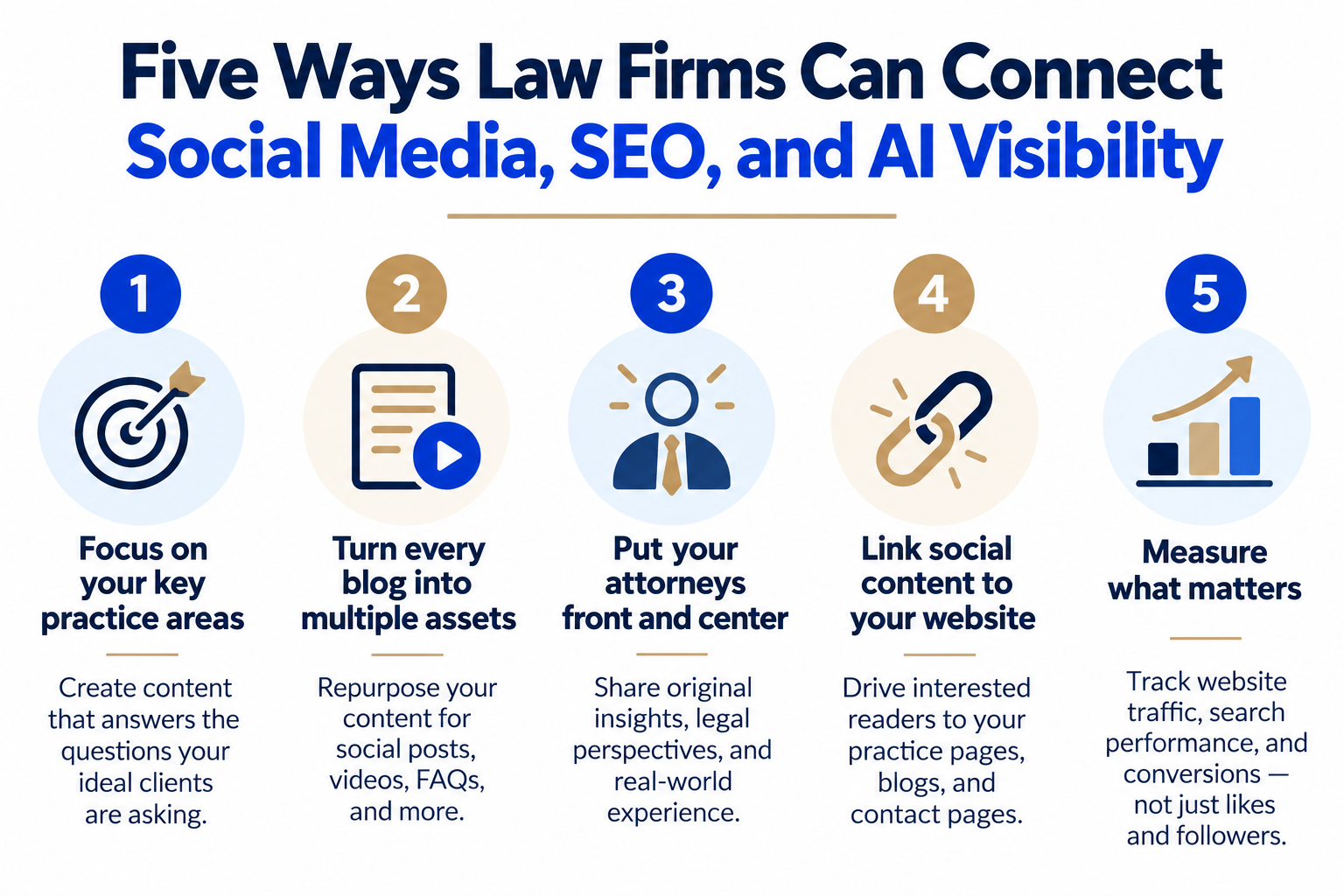
Law firms do not necessarily need larger marketing budgets. They need a more coordinated content strategy.
Here are five practical ways to get started.
1. Start With Your Most Important Practice Areas
Identify the legal services your firm most wants to grow.
For each practice area, develop content addressing specific questions prospective clients are likely to ask.
A personal injury firm, for example, might focus on truck accidents, pedestrian injuries, or wrongful death claims.
An immigration firm might focus on green cards, VAWA petitions, or removal and deportation defense.
Build related blogs, FAQs, videos, and social posts around those subjects.
2. Turn Every Important Blog Into Multiple Content Assets
A single well-researched blog can support an entire content campaign.
For example, a blog titled "What Happens When an Heir Cannot Be Found During Illinois Probate?" could become:
A LinkedIn post explaining the attorney's perspective.
A Facebook post answering one common question.
An Instagram carousel outlining the probate process.
A YouTube Short featuring an attorney answering a specific FAQ.
An updated FAQ on the firm's probate service page.
This approach extends the value of your original legal content without requiring five completely separate research projects.
3. Put Your Attorneys Front and Center
AI-generated content is abundant.
Actual attorney experience is far more distinctive.
Encourage attorneys to contribute original insights, answer questions on video, comment on legal developments, and explain how legal issues arise in practice.
Attorney biographies, professional credentials, relevant case experience, and consistent attribution across your website and social profiles also help potential clients evaluate your firm's credibility.
Remember to protect client confidentiality and comply with advertising rules when discussing cases or outcomes.
4. Connect Social Content Back to Your Website
Your law firm's website should remain the foundation of its content marketing strategy.
Social media posts can support that foundation by directing interested readers to detailed resources.
Use clear, relevant links between your social content and your:
Practice area pages.
Educational blogs and FAQs.
Attorney profiles.
Case studies and representative results, when permitted.
Contact and consultation pages.
The goal is to create a consistent experience wherever a prospective client discovers your firm.
5. Measure Visibility, Not Just Likes and Followers
Social media success should not be measured solely by engagement.
Law firms should also evaluate how their content contributes to meaningful business outcomes.
Use Google Search Console to track organic search impressions, clicks, click-through rates, and search queries.
Use Google Analytics 4 to evaluate website visits from social media, engaged sessions, and conversions such as consultation requests.
Monitor Google Business Profile performance for local visibility, calls, and website interactions.
For AI visibility, periodically test relevant legal questions across Google AI Overviews, AI Mode, ChatGPT, and other AI search tools to identify whether your firm or its content is being mentioned or cited.
These checks provide directional insights, not a complete or fixed measure of AI visibility. Results can change based on the query, platform, location, and timing.
The most important question is not how many people liked your post. It's whether your content is helping qualified prospective clients discover, trust, and contact your firm.
Does This Mean Law Firms Should Spend More on Social Media?
Not necessarily.
It means law firms should reconsider how they divide their marketing resources.
Historically, a firm might have separate budgets for SEO, blogging, social media, and video marketing.
But when one attorney interview can produce a blog, multiple social posts, a YouTube video, and several FAQs, those investments begin working together.
Rather than treating each channel as an independent expense, consider developing one coordinated content strategy that supports:
SEO + AEO + AI Search Visibility + Social Media + Local Search
The SE Ranking findings support the value of evaluating these channels together, but they do not prove that increased social posting directly causes higher Google rankings or more AI citations.
Quality, relevance, credibility, and the questions your potential clients are asking still matter.
Frequently Asked Questions About Social Media and AI Search for Law Firms
Does social media help law firms appear in Google AI Overviews?
Social media content can appear as a cited source in Google AI Overviews. SE Ranking's research found social platform links in 67.66% of the responses studied. However, that does not mean posting on social media guarantees that a particular law firm will appear.
Which social media platform is best for law firm AI visibility?
There is no single best platform. YouTube was the leading social source in Google AI Overviews in the study, while Reddit and LinkedIn were prominent among ChatGPT's social citations. Law firms should choose platforms based on their practice areas, target audiences, and content capabilities.
Can LinkedIn posts improve a lawyer's AI visibility?
LinkedIn posts may be discovered or cited by AI-powered search tools. They can also strengthen an attorney's professional presence and help distribute original legal insights. There is no guarantee that LinkedIn activity will result in AI mentions or improved organic rankings.
Should law firms prioritize social media over SEO?
No. A well-optimized website with authoritative practice pages, helpful legal blogs, local SEO, and clear conversion opportunities remains essential. Social media should complement the firm's SEO strategy rather than replace it.
How often should a law firm post on social media?
There is no proven posting frequency that guarantees better AI visibility. A manageable schedule of two or three useful posts per week may be more valuable than daily generic content. Consistency, quality, and relevance should guide the schedule.
Your Law Firm's Digital Presence Is Bigger Than Your Website
The way people discover legal services continues to evolve.
Google search results, AI Overviews, ChatGPT, YouTube, LinkedIn, and other platforms are becoming interconnected parts of the online discovery process.
For attorneys, that means publishing a great blog is only the beginning.
The next step is making sure your firm's knowledge and experience are represented consistently across the channels where prospective clients search for answers.
The latest research suggests social media deserves a place in conversations about AI visibility.
Law firms that invest in original legal content and distribute it strategically will be better positioned to build recognition, demonstrate expertise, and connect with potential clients across multiple search experiences.
Is Your Law Firm's Content Strategy Ready for AI Search?
At SEO My Law Firm, we help attorneys and law firms develop original, authoritative legal content designed to support visibility across traditional search, AI-powered search, and social media.
From SEO-optimized blogs and practice area pages to attorney FAQs, social media content, and video scripts, we help law firms turn their legal knowledge into content that answers real questions and reaches the right audiences.
Stop treating SEO and social media as separate conversations.
Contact SEO My Law Firm to discuss how an integrated legal content marketing strategy can support your firm's visibility and business development goals.