Commodity vs. Non-Commodity Content: Why Law Firms Must Stop Publishing Generic Blogs

For years, law firms have been told to publish educational blogs to improve their SEO. That advice is still true - but what qualifies as "good content" has fundamentally changed.
Today, Google, ChatGPT, Gemini, Perplexity, Claude, and other AI search engines are increasingly looking for original, experience-driven content instead of generic articles and posts that simply repeat what hundreds of other websites have already published.
In fact, Google now specifically encourages websites to create "valuable, non-commodity content" because it is far more likely to appear in AI-powered search experiences.
For law firms, this shift creates a tremendous opportunity.
The firms that publish content only they can create will become the firms AI recommends.
As the team at Content Beast explains, "Commodity content is content that anyone can create. Non-commodity content is content that only you can create." That distinction is becoming one of the most important concepts in modern SEO because Google and AI search engines are increasingly rewarding original expertise over generic information.
What Is Commodity Content?
Commodity content is information that anyone can write.
It's factual.
It's accurate.
It's helpful.
But it isn't memorable.
Google describes commodity content as material "based on common knowledge" that "typically adds little unique insight for readers."
Examples include:
10 Things to Do After a Car Accident
What Is Probate?
How Does Divorce Work in Georgia?
Understanding Personal Injury Claims
Estate Planning Checklist
There is nothing inherently wrong with these articles.
The problem is that thousands of law firms have already written nearly identical versions.
AI can summarize them in seconds because there is little unique value separating one article from another.
What Is Non-Commodity Content?
Non-commodity content contains information that cannot easily be copied or generated by AI.
According to Google's AI Optimization Guide, websites and social media should provide:
a unique point of view
first-hand expertise
original experience
people-first content
insights beyond common knowledge
Content Beast explains the difference well:
Commodity content answers common questions.
Non-commodity content explains why something happened, what was learned, and what only that expert knows through experience.
For attorneys, this is where the real opportunity begins.
Commodity vs. Non-Commodity Examples for Law Firms
Commodity Blog
What Happens After a Car Accident in Georgia?
Discusses:
insurance
police reports
medical care
deadlines
Helpful?
Yes.
Unique?
Not really.
Non-Commodity Blog
Why Our Firm Rejected a $250,000 Settlement and Won $1.8 Million at Trial
Discusses:
why the insurance company undervalued the case
evidence that changed the outcome
expert witnesses
litigation strategy
lessons other accident victims should understand
Only your firm can write that article.
Commodity Article
What Is Probate?
Non-Commodity Article
The Three Probate Mistakes We See Families Make Every Month
Include:
real examples (without revealing identities)
common misconceptions
attorney observations
practical solutions
Now you're providing experience instead of definitions.
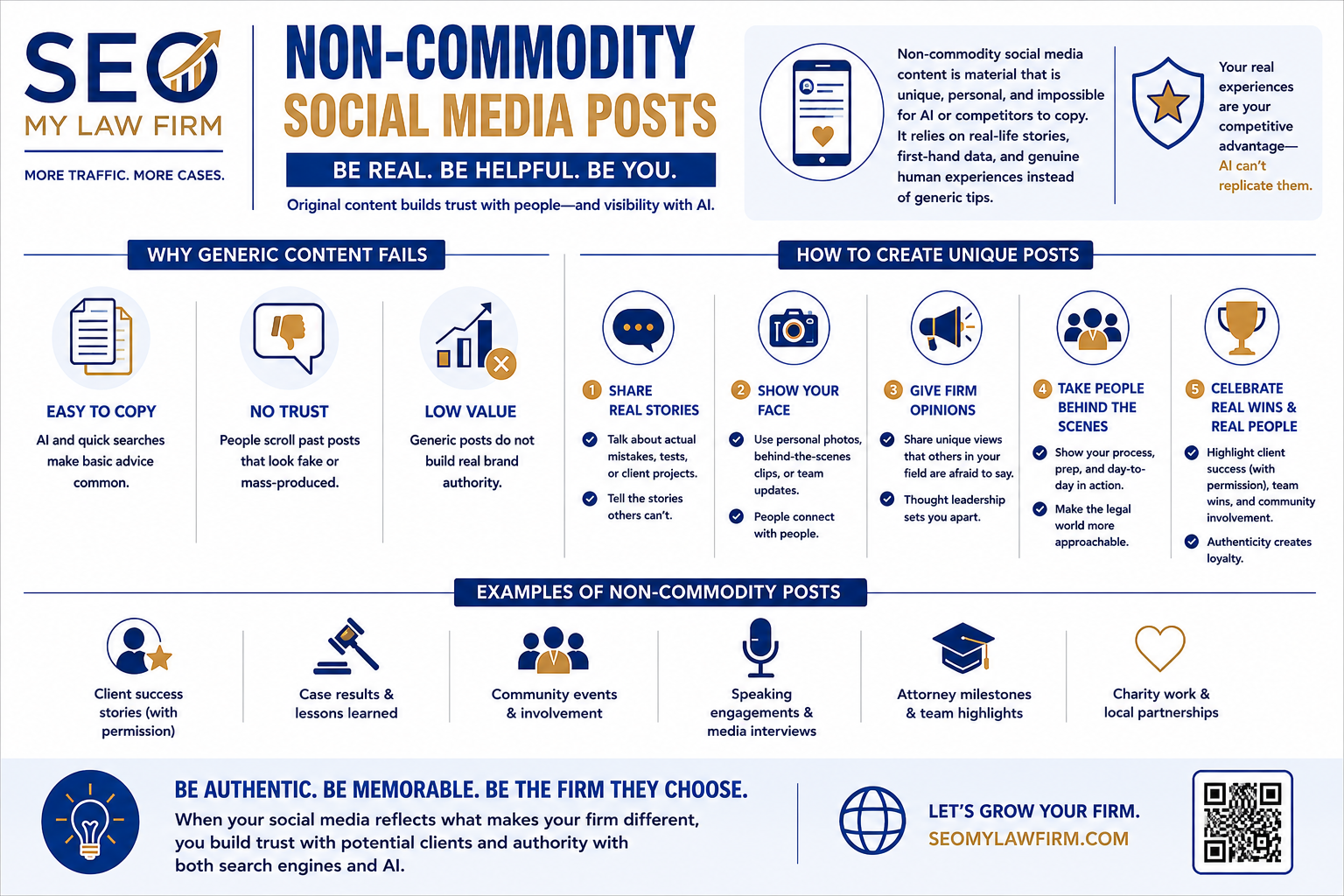
Commodity Social Media Post
How Child Custody Works in Georgia
A generic explanation of custody laws that hundreds of law firms could publish.
Non-Commodity Social Media Post
The #1 Mistake We See Parents Make Before Their First Custody Hearing
Based on your attorney's courtroom experience, this post shares a practical lesson, explains why it matters, and helps parents avoid a common error. No AI or competitor can duplicate your firm's real-world insight.
Why This Matters for AI Search
Google recently released its first official guide for optimizing websites for AI-powered search.
The very first recommendation?
Create valuable, non-commodity content including blogs and social media posts.
Google says this type of unique content will likely have a greater impact on long-term AI visibility than almost any other recommendation in the guide. Google says that "Creating content that people find unique, compelling, and useful will likely influence your website's presence in generative AI search in the long run more than any of the other suggestions in this guide."
Why?
Because AI systems compare many sources.
If every article says exactly the same thing, there is little reason to cite yours.
But when your content includes:
original legal insight
attorney opinions
real case experiences
unique examples
proprietary processes
your website becomes a source instead of simply another summary.
How to Turn Commodity Articles Into Non-Commodity Content
The good news?
You probably don't need to rewrite your entire website.
Many law firms already have dozens - or hundreds - of educational articles that simply need to be enhanced.
Google recommends adding unique value through original perspectives rather than recycling information already available elsewhere. It also advises organizing content clearly, writing for people first, and enriching pages with high-quality images and videos when appropriate.
Here are practical ways to upgrade existing legal blogs.
Add Attorney Commentary
After explaining the law, include:
"In our experience..."
or
"One mistake we frequently see clients make..."
This immediately differentiates your content.
2. Include Real Case Examples
Without revealing confidential information, explain:
what happened
what challenges arose
what ultimately resolved the case
Stories make legal concepts memorable.
3. Explain Local Court Practices
Every jurisdiction is different.
Discuss:
local judges
filing procedures
county-specific timelines
practical expectations
That information has much greater value than generic legal definitions.
4. Answer Questions Clients Actually Ask
Instead of relying only on keyword research, review:
consultation notes
intake calls
FAQs
Google Business Profile questions
comments on social media
These reveal the real concerns people have before hiring an attorney.
5. Add Original Photos and Videos
Google specifically notes that generative AI search can surface relevant images and videos alongside web content, creating additional opportunities for visibility.
For law firms, consider adding:
attorney videos
courtroom explanations
office photos
legal process graphics
FAQ videos
YouTube Shorts
Content Ideas Every Law Firm Already Has
Your best content often isn't hidden in keyword tools.
It's already inside your practice.
Consider writing and posting about:
Cases that taught valuable lessons
Frequently misunderstood laws
Common client mistakes
Insurance company tactics you've encountered
Changes in local court procedures
Emerging legal issues
Behind-the-scenes explanations of your legal process
Answers to questions you hear every week
These topics demonstrate experience and expertise that AI cannot invent.
SEO Is Still the Foundation
Some marketers have suggested that SEO is dead and has been replaced by AEO or GEO.
Google disagrees.
Its AI Optimization Guide makes it clear that traditional SEO best practices remain the foundation for visibility in both classic search and generative AI experiences. Rather than chasing AI-specific "hacks," Google recommends focusing on technical SEO, clear site structure, and unique, people-first content.
The future isn't choosing between SEO and AI optimization.
It's combining them.
Strong keyword research.
Clear site architecture.
Helpful legal information.
Original attorney insight.
Experience that only your firm possesses.
That combination creates content that both search engines and AI systems want to recommend.
The Future Belongs to Original Expertise
The days of publishing another generic "10 Tips" article simply to fill a content calendar are ending.
AI can already summarize generic legal information.
What AI cannot replace is your firm's experience.
Every consultation.
Every courtroom appearance.
Every negotiation.
Every settlement.
Every trial.
Those experiences create insights that no AI can manufacture.
The law firms that consistently publish those insights won't just rank higher - they'll become trusted sources that Google, ChatGPT, Gemini, Claude, and Perplexity increasingly rely on when answering legal questions.
Frequently Asked Questions About Non-Commodity Content
What is commodity content?
Commodity content covers common topics in a generic way and offers little unique value beyond what is already widely available online.
What is non-commodity content?
Non-commodity content includes original experience, expert opinion, case examples, local knowledge, proprietary processes, or unique insights that cannot easily be copied or generated by AI.
Does Google prefer non-commodity content?
Yes. Google's AI Optimization Guide specifically recommends creating valuable, unique, non-commodity content because it is more likely to perform well in generative AI search experiences.
Should law firms delete all of their existing blogs?
Usually not. Many existing articles can be significantly improved by adding attorney commentary, original examples, local insights, FAQs, videos, and practical guidance that reflects the firm's real experience.
What is a non-commodity social media post, and why does my law firm need them?
A non-commodity social media post is content that only your law firm can create because it is based on your attorneys' experience, real client stories (with permission), case results, behind-the-scenes moments, professional opinions, or community involvement. Unlike generic legal tips that can be copied by competitors or generated by AI, non-commodity posts build trust, showcase your firm's unique expertise, and help differentiate your brand. They also support your firm's overall SEO, AI visibility, and authority by demonstrating the real-world experience and authenticity that both potential clients and search engines increasingly value.
Can AI-generated articles rank?
AI can help with drafting and research, but content that simply repeats widely available information is less likely to stand out. The most successful law firm content combines AI-assisted efficiency with genuine attorney expertise and original insights.
Ready to Make Your Law Firm's Content Stand Out?
If your website is filled with generic legal blogs and social media posts that sound like every other firm's, you're missing an opportunity to become a trusted source for both Google and AI search engines.
At SEO My Law Firm, we help attorneys transform commodity content into authoritative, experience-driven articles that improve SEO, increase AI visibility, build trust, and generate qualified leads.
Ready to future-proof your legal content? Contact SEO My Law Firm today to learn how strategic, non-commodity content can help your firm get found - and cited - where today's clients are searching.